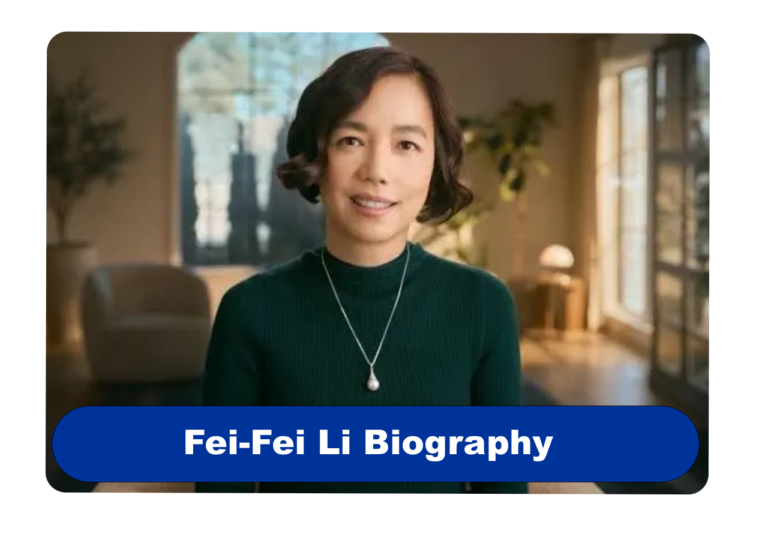
Fei-Fei Li biography covering her age, education, ImageNet breakthrough, Stanford career, husband, World Labs, AMD acquisition agreement, awards and net worth.
The Fei-Fei Li biography connects one of modern artificial intelligence’s most important breakthroughs with an immigrant story, an academic career and a growing role in AI entrepreneurship. Li is a Chinese-born American computer scientist best known for leading the creation of ImageNet, the visual database and benchmark that helped accelerate progress in computer vision and deep learning.
She is the inaugural Sequoia Professor in Stanford University’s Computer Science Department and co-director of the Stanford Institute for Human-Centered Artificial Intelligence. In 2024, she co-founded World Labs to pursue spatial intelligence. In September 2026, AMD agreed to acquire the company in an all-stock transaction valued at about $8.2 billion.
Fei-Fei Li Quick Facts
| Detail | Information |
|---|---|
| Full Name | Fei-Fei Li |
| Date of Birth | July 3, 1976 |
| Age | 50 years old as of 2026 |
| Birthplace | Beijing, China |
| Raised In | Chengdu, China |
| Nationality | Chinese-born American |
| Occupation | Computer scientist, professor and entrepreneur |
| Education | Princeton University; California Institute of Technology |
| Known For | ImageNet, computer vision and human-centered AI |
| Stanford Role | Sequoia Professor of Computer Science; co-director of Stanford HAI |
| Company | Co-founder and CEO of World Labs |
| Husband | Silvio Savarese |
| Children | Two |
| Book | The Worlds I See |
Early Life and Immigration
Fei-Fei Li was born in Beijing in 1976 and grew up in Chengdu, China. Her father moved to the United States first, and Li later immigrated with the rest of her family as a teenager.
They settled in Parsippany, New Jersey, where she attended Parsippany High School while still learning English. The family had limited financial resources, and Li worked in a Chinese restaurant before helping her parents operate a dry-cleaning business.
Her family’s experience as immigrants later became an important part of the way Li explained her life and scientific career. She has often connected curiosity with the willingness to enter unfamiliar territory and learn from uncertainty.
Princeton and Caltech
Li entered Princeton University and studied physics, graduating with high honours in 1999.
Her interests moved increasingly toward intelligence, human vision and the question of how people understand the world they see.
Li continued her education at the California Institute of Technology, where she earned a PhD in electrical engineering in 2005. Her doctoral research examined visual recognition, computational models and human perception.
She joined Stanford University in 2009 and later served as director of the Stanford Artificial Intelligence Laboratory from 2013 to 2018.
Today, her Stanford research spans computer vision, machine learning, deep learning, cognitively inspired AI, robotic learning and applications of AI in healthcare. She has contributed to more than 200 scientific publications during her academic career.
Why ImageNet Changed Artificial Intelligence
ImageNet is the project most closely associated with Li’s name.
In the 2000s, computer-vision researchers faced a basic problem: algorithms needed far more labelled visual data to learn reliably. Li and her collaborators pursued an ambitious answer by building a database containing millions of images organised into thousands of object categories.
The ImageNet project was introduced academically in 2009 and eventually grew to roughly 15 million images across about 22,000 categories.
Its influence increased through the ImageNet Large Scale Visual Recognition Challenge, which allowed research teams to compare computer-vision systems using the same benchmark.
A turning point came in 2012 when a University of Toronto team led by Geoffrey Hinton and including Alex Krizhevsky and Ilya Sutskever used a deep neural network to achieve a major improvement in the competition.
ImageNet did not invent deep learning, but it helped demonstrate how large datasets, computing power and neural networks could dramatically improve machine vision.
Its influence later extended far beyond image classification. The success of deep-learning systems in the ImageNet competition became one of the events that accelerated investment and research across modern artificial intelligence.
Google Cloud and Human-Centered AI
Li took a sabbatical from Stanford between 2017 and 2018 to work at Google, where she served as a vice president and Chief Scientist of AI and Machine Learning at Google Cloud.
She later returned to Stanford and became one of the founders of the Stanford Institute for Human-Centered Artificial Intelligence, commonly known as Stanford HAI.
The institute brings together researchers from computer science, medicine, law, economics, social science and other disciplines.
Its approach reflects a major theme in Li’s work: artificial intelligence should be developed with an understanding of how it affects people and institutions rather than being measured only by technical performance.
Li has also participated in public discussions about AI governance and has testified before U.S. lawmakers on issues surrounding responsible artificial intelligence.
AI4ALL
Li has argued that the people developing artificial intelligence should better represent the societies affected by it.
In 2015, she helped create a Stanford summer programme introducing high-school girls to AI. The programme helped inspire AI4ALL, which was formally established in 2017.
The nonprofit expanded the idea beyond Stanford and works to make AI education more accessible to groups historically underrepresented in technology.
Li remains associated with AI4ALL as a co-founder and board member.
The Worlds I See
In 2023, Li published The Worlds I See: Curiosity, Exploration, and Discovery at the Dawn of AI.
The memoir combines the development of modern computer vision with her experience as an immigrant, student, scientist and daughter.
Rather than functioning only as a technical history of artificial intelligence, the book explains how family responsibilities, immigration and scientific curiosity influenced her work.
Princeton later selected The Worlds I See as its Pre-read for the Class of 2028, giving incoming students a shared text for discussions about technology, discovery and human responsibility.
World Labs and Spatial Intelligence
Li entered a new phase of her career in 2024 when she co-founded World Labs with Justin Johnson, Ben Mildenhall and Christoph Lassner.
The company focuses on spatial intelligence: developing AI systems capable of reasoning about three-dimensional environments, objects and physical relationships.
World Labs raised $230 million when it emerged publicly in 2024.
In February 2026, the company announced another $1 billion funding round backed by investors including AMD, Nvidia, Autodesk, Fidelity Management & Research Company and Emerson Collective.
Its first major product, Marble, can generate persistent 3D worlds from inputs including text, images, video and 3D layouts.
The company’s ambitions extend beyond creating virtual environments. Spatially intelligent systems could eventually have applications in robotics, simulation, design, scientific research and technologies that need to understand and interact with physical spaces.
AMD’s $8.2 Billion World Labs Agreement
On September 28, 2026, AMD announced a definitive agreement to acquire World Labs in an all-stock transaction valued at approximately $8.2 billion.
The agreement represents one of the most significant developments in Li’s career outside academia.
The transaction is expected to close by the end of 2026, subject to customary closing conditions.
Until that process is completed, Li remains CEO of World Labs.
Under the announced arrangement, she is expected to become AMD’s executive vice president and chief scientist, reporting to AMD chair and CEO Lisa Su, after the acquisition closes.
The deal also brings together two companies that already had a relationship. AMD participated in World Labs’ 2026 funding round, and the companies had collaborated on computing infrastructure for World Labs’ AI models.
Awards and Recognition
Li has received numerous honours for her work in artificial intelligence.
She was elected to both the National Academy of Engineering and the National Academy of Medicine in 2020 and became a member of the American Academy of Arts and Sciences in 2021.
Her more recent honours include Princeton University’s Woodrow Wilson Award and the VinFuture Grand Prize in 2024.
In 2025, Li was among the recipients of the Queen Elizabeth Prize for Engineering for contributions to modern machine learning.
She was also included among the group of AI pioneers recognised by Time as the magazine’s 2025 Person of the Year, under its “Architects of AI” designation.
Fei-Fei Li Husband and Children
Fei-Fei Li is married to computer scientist Silvio Savarese.
Savarese is a Stanford professor and has also held senior artificial-intelligence leadership positions in the technology industry. His academic work includes computer vision and machine learning.
The couple has two children, a son and a daughter.
Li has discussed balancing research, teaching and family responsibilities, but she generally keeps her children’s identities and personal lives away from public attention.
Fei-Fei Li Net Worth
Fei-Fei Li’s exact personal net worth has not been publicly disclosed.
Her career includes a Stanford professorship, senior work at Google and an ownership interest in World Labs. However, those facts do not provide enough information to calculate her current personal wealth accurately.
The proposed $8.2 billion World Labs acquisition should not be confused with Li’s net worth.
That amount represents the announced value of the entire company in an all-stock transaction. World Labs has other founders, employees and outside investors, and Li’s precise ownership percentage has not been publicly established.
The acquisition could substantially affect her personal financial position, but assigning her a specific net-worth figure without confirmed information about her shares, other assets and liabilities would be speculation.
For that reason, internet estimates claiming a precise Fei-Fei Li net worth should be treated cautiously.
Conclusion
Fei-Fei Li has influenced artificial intelligence at several important stages of its modern development.
ImageNet helped provide the data and benchmark that accelerated computer vision. Her work at Stanford pushed human-centered questions further into mainstream AI research, while AI4ALL addressed who gets opportunities to participate in building the technology.
World Labs has now placed her at the centre of another emerging field: spatial intelligence.
The September 2026 agreement for AMD to acquire the company adds a major new chapter to the Fei-Fei Li biography. Yet the thread connecting her work remains remarkably consistent—the attempt to build machines that better understand the world while keeping human needs and responsibilities at the centre of technological progress.
Frequently Asked Questions
Who is Fei-Fei Li?
Fei-Fei Li is a Chinese-born American computer scientist, Stanford professor and entrepreneur. She is best known for leading the creation of ImageNet and for her research in computer vision, human-centered AI and spatial intelligence.
How old is Fei-Fei Li?
Fei-Fei Li was born on July 3, 1976. She is 50 years old as of September 2026.
What did Fei-Fei Li create?
Li is best known for ImageNet, the large-scale image database and benchmarking project that played an important role in the development of modern computer vision and deep learning.
Who is Fei-Fei Li’s husband?
Fei-Fei Li is married to computer scientist and Stanford professor Silvio Savarese. They have two children.
What is World Labs?
World Labs is an artificial-intelligence company co-founded by Fei-Fei Li that develops spatial-intelligence models capable of understanding and generating three-dimensional environments.
Is Fei-Fei Li joining AMD?
Under AMD’s September 2026 acquisition agreement, Li is expected to become AMD’s executive vice president and chief scientist after the World Labs transaction closes. As of September 29, 2026, the acquisition has been announced but is not yet completed.
What is Fei-Fei Li’s net worth?
Fei-Fei Li’s exact net worth has not been publicly verified. The announced $8.2 billion value of World Labs represents the value of the company in the proposed transaction, not Li’s personal wealth.